A first suspected seizure needs prompt medical assessment, while a second unprovoked seizure often changes the likelihood of epilepsy and the need for specialist care. You will learn when to call emergency services, what episodes count as possible seizures, what to record, and what a neurologist may do next.
Key takeaways
- Call emergency services for a seizure lasting five minutes or repeated seizures without recovery.
- Arrange first-seizure assessment within two weeks, even after you feel fully recovered.
- Record timing, movements, awareness, injuries, triggers, medicines, and recovery after each event.
- Ask for medication review when seizures continue, side effects appear, or doses are missed.
When should you seek emergency care or arrange an urgent assessment?
Arrange urgent assessment after a first suspected seizure, even if you have recovered. A clinician experienced in first seizures should ideally review you within two weeks.
One event does not automatically mean epilepsy, but testing can support diagnosis after one unprovoked seizure when the predicted 10-year recurrence risk is at least 60% or an epilepsy syndrome is identified.
| Situation | Action | Why it matters |
|---|---|---|
| First suspected seizure | Arrange assessment within two weeks | Fainting, migraine, functional seizures, and other conditions can look similar |
| Second unprovoked seizure | Seek urgent neurology review | The usual epilepsy diagnosis threshold is two unprovoked seizures more than 24 hours apart |
| Recurring seizures | Do not dismiss them as isolated events | Repeated staring, unresponsiveness, unusual sensations, jerking, or nocturnal movements may indicate epilepsy |
Call emergency services rather than waiting for a routine appointment if any of these apply:
- A seizure lasting five minutes or longer, or repeated seizures without recovery of consciousness between them
- Breathing difficulty, blue lips, or failure to wake normally
- Serious injury, a seizure in water, or prolonged confusion
- A new weakness, speech problem, severe headache, fever, or neck stiffness
- Pregnancy or recent childbirth, diabetes, or possible poisoning
These signs can indicate status epilepticus, stroke, infection, bleeding, or a dangerous metabolic problem. A second unprovoked seizure without emergency features still requires prompt neurological assessment, not watchful waiting.
What counts as a recurring seizure, and what else can look like one?
Epilepsy is usually diagnosed after two unprovoked seizures more than 24 hours apart. Recurrence can be subtle: repeated, highly similar episodes of staring spells, unresponsiveness, brief jerking, memory gaps, or nocturnal movements deserve assessment even when nobody sees a convulsion.
Focal seizures can begin with déjà vu, sudden fear, unusual smells, a rising stomach sensation, or other seizure warning symptoms, then cause staring, lip-smacking, wandering, or confusion. Absence seizures cause abrupt staring and impaired awareness for seconds, often many times daily. These patterns are clues, not proof; time each event and obtain safe eyewitness video.
| Episode | Clues that favour it | Important limitation |
|---|---|---|
| Fainting | Standing, heat, pain, nausea, pallor, and a slow collapse; brief jerking can occur | Recovery is usually rapid |
| Panic attack | Fear, racing heart, breathlessness, and tingling with continuous awareness | Sudden fear can be a focal seizure warning |
| Sleep disorder | Nocturnal movements, sleepwalking, or dream enactment linked to sleep stages | Repeated, identical night events need review |
| Migraine aura | Visual or sensory symptoms spread gradually over minutes, often followed by headache | Sudden fixed symptoms fit less well |
| Transient ischaemic attack | Sudden weakness, numbness, or speech loss without rhythmic jerking | A TIA needs urgent medical assessment |
| Movement disorder | Tics, tremor, or dystonia with preserved awareness and a consistent pattern | Awareness can occasionally be affected |
| Psychogenic nonepileptic seizures | Variable duration, fluctuating movements, or prolonged episodes | Confirmation requires specialist video-EEG assessment |
These seizure mimics can coexist with epilepsy. A neurologist compares triggers, awareness, movements, recovery, and video rather than relying on one feature.
What should you record before seeing a neurologist?
Use a clock rather than estimating the seizure duration. Start when the first change appears and record when awareness, movements, and normal breathing return; note the date, time, location, and what you were doing.
| Record | Details to capture | Why it helps |
|---|---|---|
| Timing and symptoms | Staring, unresponsiveness, jerking, stiffening, unusual smells, déjà vu, fear, tongue biting and incontinence | Shows the event’s sequence and possible seizure type |
| Recovery | Confusion, sleepiness, headache, weakness, injury, and how long recovery took | Separates post-seizure symptoms from other episodic conditions |
| Triggers and health | Sleep deprivation, alcohol, fever, illness, stress, hormonal changes, and recent injury | Identifies circumstances linked to breakthrough events |
| Medication | Drug names, dose, timing, medication adherence, missed doses, side effects, and new medicines | Prevents guessing that missed medication alone caused the seizure |
Ask an eyewitness to write an eyewitness account while the details are fresh. A witness video can show eye position, movements, responsiveness, breathing, and recovery; record only when this is safe, never delay first aid or emergency care to film.
Keep every event in a seizure diary, including brief episodes and night-time movements. Bring the diary, medication packets or an updated list, and relevant medical records; do not stop or change treatment without medical advice. A seizure lasting five minutes or longer requires emergency care, not diary-taking.
What happens at the first neurology consultation?
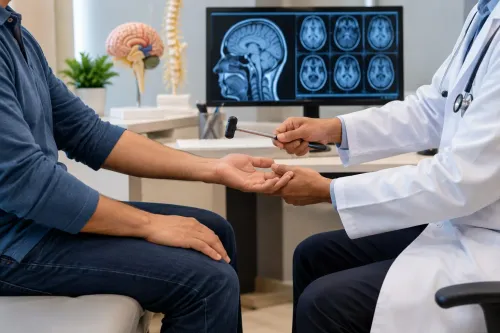
A first neurology consultation begins by reconstructing the event, not by ordering every available test. The neurologist will compare your account with an eyewitness description or video, ask about awareness, movements, duration, recovery, sleep, alcohol, missed medication, injuries, and previous episodes, then consider fainting, migraine, panic, or functional seizures.
The neurological examination checks alertness, speech, eye movements, strength, sensation, coordination, walking, and reflexes. Abnormal findings can suggest a structural or vascular cause; a normal examination does not exclude epilepsy.
Tests are chosen to answer specific questions:
| Test | What it helps assess | When it applies |
|---|---|---|
| Routine EEG | Interictal electrical patterns and seizure classification | Initial assessment |
| Sleep-deprived EEG | Abnormalities missed while awake | Normal routine EEG with continuing uncertainty |
| Ambulatory EEG | Brain activity during usual activities, often up to 48 hours | Infrequent or unclear episodes |
| Video-EEG | Whether symptoms match an electrical seizure | Diagnosis remains uncertain or events need capture |
| MRI epilepsy protocol | Structural causes and treatment planning | Most people diagnosed with epilepsy |
| Blood tests | Glucose, electrolytes, infection, organ function, or medication effects | When history or examination suggests a metabolic cause |
| ECG | Heart-rhythm causes of collapse that can mimic seizures | Blackouts or uncertain loss of consciousness |
The neurologist will explain routine EEG limitations: a normal routine EEG does not prove epilepsy is absent. Dr Jharna P Mahajan (Bhanushali) can use the timing and features in your seizure record to decide whether prolonged monitoring or another diagnosis deserves priority.
Related service
Epilepsy and Seizure Disorders Epilepsy and Seizure Disorders Seizures can result from various causes—genetic, structural, infectious, metabolic, or idiopathic. Dr. View service → |
When do recurring seizures require medication review or an epilepsy specialist?
Seek epilepsy specialist review once seizures continue despite two appropriately chosen and tolerated antiseizure medication schedules, used alone or in combination. This meets the definition of drug-resistant epilepsy; ask for referral to a tertiary epilepsy service rather than continuing indefinite medication changes without a plan.
Arrange an antiseizure medication review after breakthrough seizures or whenever treatment affects daily life. Request specialist assessment if:
- Seizures continue after the first medicine, or the second medicine is being considered.
- The diagnosis or seizure type remains uncertain, including episodes of staring, falls, impaired awareness, or unusual night-time movements.
- Side effects such as severe sleepiness, mood changes, poor concentration, dizziness, rash, or coordination problems are disabling.
- You are considering pregnancy planning. Do not stop medication suddenly; discuss fetal risks, seizure risks, medicine changes, and folic acid before conception.
- You have night-time convulsions, injuries, or uncontrolled generalized tonic-clonic seizures.
Night-time convulsions deserve prompt review because uncontrolled seizures during sleep increase concern about SUDEP, or sudden unexpected death in epilepsy. Discuss seizure safety, medication adherence, avoidable triggers, nocturnal supervision, and suitable safety devices.
A seizure lasting five minutes, repeated seizures without recovery, breathing difficulty, or serious injury needs emergency care, not a routine referral.
Frequently asked questions
When should you seek emergency care for a seizure?
Seek emergency care for a seizure lasting five minutes, repeated seizures without recovery, breathing difficulty, serious injury, a seizure in water, pregnancy, diabetes, or a first suspected seizure requiring urgent assessment.
What counts as a recurring seizure?
Recurring seizures are repeated episodes caused by abnormal electrical activity in the brain. Fainting, panic attacks, sleep disorders, migraine, and movement disorders can look similar, so clinical assessment is important.
What should you record before seeing a neurologist?
Record the date, time, duration, warning symptoms, movements, awareness, breathing, injuries, possible triggers, medicines, missed doses, and the recovery period. Ask a witness to describe the event or record it safely.
What happens at the first neurology consultation?
The neurologist reviews the event history, witness account, medical history, medicines, examination findings, and safety concerns. They may arrange tests such as an EEG, brain imaging, or blood tests.
When do recurring seizures require medication review or an epilepsy specialist?
Arrange medication review when seizures continue, side effects interfere with daily life, doses are missed, or treatment changes are needed. Ask about an epilepsy specialist when seizures remain uncontrolled or the diagnosis is uncertain.