
Tingling or burning is not enough to identify the problem: the timing, body pattern, progression and associated weakness often matter more than the sensation itself. You will learn which warning signs need emergency care, when to arrange a neurologist appointment, and what information and tests can make the evaluation more useful.
Key takeaways
- Seek emergency care for rapidly worsening weakness, foot drop, or breathing difficulty.
- Burning in both feet often points to length-dependent nerve involvement.
- Persistent, spreading, or function-limiting tingling warrants neurological assessment.
- Bring a symptom timeline, medication list, medical history, and previous test results.
When numbness or weakness needs emergency assessment
Seek emergency assessment rather than waiting for a routine neurology appointment if weakness is rapidly progressive over hours or days, you develop a new foot drop, or walking becomes difficult. Difficulty swallowing or breathing is an emergency, even without pain.
Loss of bladder or bowel control or saddle numbness—the loss of sensation around the inner thighs, buttocks or genitals—can signal serious nerve or spinal-cord compression.
| Warning pattern | Why it matters | What to do |
|---|---|---|
| Rapidly spreading weakness | Guillain–Barré syndrome can worsen quickly and affect breathing muscles and autonomic function, including blood pressure and heart rate | Go to an emergency department now |
| New foot drop or rapidly worsening walking difficulty | A significant motor-nerve, nerve-root or spinal-cord problem may be developing | Seek urgent assessment today |
| Loss of bladder or bowel control with saddle numbness | Cauda equina compression can cause permanent weakness or incontinence if treatment is delayed | Call emergency services or attend the emergency department |
| Sudden one-sided numbness with facial drooping, speech trouble or confusion | These are possible stroke symptoms | Call emergency services immediately |
Do not drive yourself when breathing, swallowing, walking or speech is affected. Sudden one-sided symptoms require urgent assessment even if they improve, because a brief episode can still represent a transient ischaemic attack.
What the symptom pattern can reveal about the cause
The map of symptoms often matters more than the words “burning” or “numbness.” Length-dependent polyneuropathy usually begins in both toes or feet and moves upward symmetrically. A focal entrapment neuropathy instead follows one nerve, as in median-nerve carpal tunnel syndrome affecting the thumb, index finger, middle finger and part of the ring finger.
| Pattern | Possible cause | Clue |
|---|---|---|
| Both toes or feet, spreading upward | Length-dependent polyneuropathy | Symmetric “stocking” distribution |
| Thumb, index and middle fingers | Focal entrapment neuropathy | Fits median-nerve carpal tunnel syndrome |
| One hand, foot or limb | Nerve compression or another focal disorder | Asymmetry is atypical for usual polyneuropathy |
| Back into the leg or arm | Pinched nerve or radiculopathy | Follows a nerve root from the spine |
| Band around the torso | Spinal cord disease | A trunk-level sensory boundary is concerning |
| One side of the body or face | Central disorder | Brain or brainstem involvement is possible |
Muscle disease causes weakness without numbness or altered pinprick sensation. Vascular disease points toward coldness, colour change, exertional pain or weak pulses, while joint problems cause local pain, stiffness and restricted movement.
Medication effects, including excessive vitamin B6 from supplements, and vitamin B12 deficiency can produce diffuse sensory symptoms; the timing, medicine list and blood tests help separate them from structural nerve disease. Symptoms in the trunk, face, one limb or a distinctly asymmetric pattern deserve neurological assessment.
When persistent tingling warrants a neurologist
Arrange a neurology appointment if tingling, numbness or burning lasts more than a few weeks, worsens, disrupts sleep, or starts affecting walking. This is when to see a neurologist for neuropathy, even without emergency symptoms.
- Seek specialist assessment for balance problems, weakness or recurrent falls.
- Arrange evaluation for a motor-predominant, asymmetric, proximal or multifocal pattern rather than the usual symptoms beginning in both feet.
- Prioritise referral if you have diabetes, chemotherapy exposure, heavy alcohol use, kidney disease, thyroid disease, autoimmune illness or a family history of neuropathy.
- Report autonomic symptoms, including fainting on standing, abnormal sweating, early fullness, vomiting, constipation or diarrhoea, urinary retention, sexual dysfunction or unexplained resting tachycardia.
These risk factors can point to treatable causes such as vitamin B12 deficiency, medication or toxin exposure, autoimmune disease, kidney or thyroid disease, monoclonal gammopathy or inherited neuropathy. Autonomic symptoms can require testing and treatment beyond pain medication.
Severe burning feet can indicate small-fiber neuropathy even when strength is normal and routine nerve-conduction studies are normal. Those studies mainly assess large fibres; persistent burning or altered temperature sensation may lead to skin biopsy or autonomic testing.
Check supplements carefully: excessive vitamin B6, also called pyridoxine, in multivitamins, energy products or combination preparations can itself cause sensory neuropathy.
What a neurologist examines and which tests answer which questions
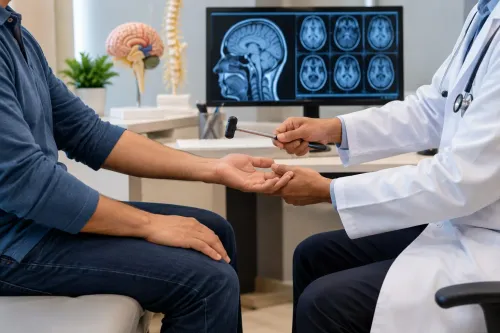
A neurological examination for neuropathy tests strength, reflexes, sensation, walking and balance. The clinician also checks for nerve compression at sites such as the wrist, elbow or ankle, and looks for spinal-cord or brain signs that suggest a different diagnosis.
- Strength testing looks for weakness, wasting or a pattern pointing to a nerve root, muscle or motor nerve.
- Reflexes and pinprick, temperature, vibration and position sense show which sensory fibres are affected.
- Gait, heel-to-toe walking, standing with feet together and coordination reveal balance problems.
| Test | Question it answers | When it applies |
|---|---|---|
| Fasting glucose or HbA1c | Is diabetes contributing? | Initial evaluation |
| Two-hour oral glucose-tolerance test | Is impaired glucose tolerance present despite normal routine glucose results? | Suspected neuropathy with normal fasting glucose or HbA1c |
| Vitamin B12 tests | Is deficiency damaging nerves? | Unexplained sensory symptoms |
| Thyroid-stimulating hormone | Is thyroid disease involved? | Routine screening |
| Kidney and liver function | Is organ disease affecting nerves or drug handling? | Initial evaluation |
| Complete blood count | Is anemia or another blood abnormality present? | Initial evaluation |
| Serum protein electrophoresis with immunofixation | Is a monoclonal gammopathy present? | Unexplained or atypical neuropathy |
Nerve-conduction studies measure large-fibre signal speed and strength; electromyography assesses muscle and nerve-root function. Together they help classify axonal or demyelinating disease, identify radiculopathy and clarify weakness. Normal results do not exclude small-fiber neuropathy.
Burning pain with abnormal temperature or pin sensation may lead to skin biopsy for intraepidermal nerve-fibre density, autonomic testing, or targeted spinal or brain imaging.
How to prepare for the appointment and decide what needs follow-up
Map the symptoms before the appointment: mark the exact areas on a body diagram and record the onset date, speed of progression, triggers, pain quality, weakness, falls, sleep disruption, and autonomic symptoms such as dizziness on standing, sweating changes, constipation or urinary difficulty. Add recent infections, chemotherapy, alcohol use, supplements and family history.
1. Bring every medicine and supplement, including multivitamins, energy products and combination preparations. Include dose and start date if known. This review can uncover medication-induced neuropathy or vitamin B6 toxicity from excessive pyridoxine.
2. Prepare questions to ask a neurologist: What cause fits this pattern? Which tests are necessary? Could this be B12 deficiency, thyroid or kidney disease, autoimmune disease, monoclonal gammopathy or inherited neuropathy? Should any medicine change, and when is follow-up needed?
3. Expect the assessment to determine the next decision: treat an identified cause, arrange nerve studies or targeted testing, monitor stable symptoms, or review progression sooner. Painful diabetic neuropathy treatment may include a tricyclic antidepressant, serotonin–norepinephrine reuptake inhibitor or gabapentinoid; routine long-term opioids are not preferred.
4. Protect numb feet now. Inspect them daily, avoid barefoot walking and heating pads or hot water, and wear properly fitted shoes. Report blisters, burns, colour change or nonhealing wounds promptly.
An evaluation with Dr Jharna P Mahajan (Bhanushali) can use your symptom map and examination findings to select appropriate testing and set a clear follow-up plan.
Related service
Neuropathy and Nerve Pain Neuropathies can be localized or systemic, with symptoms like tingling, burning, weakness, or numbness. Dr. View service → |
Frequently asked questions
When does numbness or weakness need emergency assessment?
Seek emergency assessment when weakness progresses over hours or days, a new foot drop appears, walking becomes difficult, or swallowing or breathing becomes difficult.
What can the pattern of tingling, burning, or numbness reveal?
Symptoms in both feet that gradually spread upward suggest length-dependent peripheral nerve involvement, while one-sided or focal symptoms can point to a compressed nerve or nerve root.
When should persistent tingling be assessed by a neurologist?
Arrange a neurological assessment when tingling persists, spreads, causes weakness or imbalance, disrupts sleep, or affects walking, hand use, or daily activities.
What does a neurologist examine for peripheral neuropathy?
The examination checks strength, reflexes, sensation, balance, coordination, walking, and the distribution of symptoms. Blood tests, nerve conduction studies, electromyography, or imaging answer different diagnostic questions.
How should you prepare for a peripheral neuropathy appointment?
Record when symptoms began, where they occur, how they have changed, and what worsens them. Bring a medication and supplement list, medical history, diabetes information, and previous test results.