
Weakness means losing the ability to generate force, not simply feeling tired after a demanding day. By tracking how long it lasts, which movements fail, how symptoms change with activity, and whether warning signs are present, you can decide between emergency care, a routine medical assessment, and a neurology consultation.
Key takeaways
- Persistent unexplained weakness that affects daily tasks deserves medical assessment.
- Sudden weakness, facial drooping, speech trouble, or breathing difficulty needs emergency care.
- Weakness in hips and shoulders points to a different problem than hand or foot weakness.
- A neurologist may assess strength, reflexes, sensation, movement, and targeted test results.
What Counts as Persistent Muscle Weakness?
Persistent muscle weakness means a reduced ability to generate force that continues, returns repeatedly, or fails to improve after sleep and ordinary rest. There is no universal number of days before referral; unexplained weakness that persists beyond an expected recovery deserves assessment, especially when it worsens or affects daily tasks.
Fatigue versus weakness becomes clearer when you test function. Fatigue feels like low energy or an inability to sustain effort, while true weakness prevents a specific action even when you are alert and trying. Pain-limited movement, breathlessness, poor balance, tremor, numbness, and sleepiness can also feel like weakness but have different causes.
Objective muscle strength testing compares individual muscle groups on both sides and checks reflexes, sensation, coordination, and walking. At home, note whether you struggle to rise from a chair, climb stairs, lift your arms, open jars, button clothes, grip objects, or lift the front of a foot. Arrange medical assessment if:
- The limitation does not improve with rest, or steadily worsens.
- You fall, lose independence, notice muscle wasting, or cannot perform familiar tasks.
- Weakness comes with numbness, burning pain, reduced sensation, abnormal reflexes, or new coordination problems.
- Muscle pain, severe tenderness, fever, or dark urine accompanies the weakness.
- Loss of strength develops over hours to days, affects one side, or comes with facial droop, speech trouble, swallowing difficulty, or breathing problems; seek emergency care.
The Pattern of Weakness Often Shows Where the Problem Lies
Climbing stairs, rising from a chair, lifting your arms, or combing your hair tests proximal strength. Difficulty opening jars, buttoning clothes, gripping objects, or lifting the front of your foot tests distal strength. The distribution often narrows the cause more reliably than the word “weakness” alone.
- Proximal weakness affecting both sides, with normal sensation, points toward muscle disease. Thyroid disorders, electrolyte abnormalities, inflammatory myopathies, inherited disorders, and medication effects can produce this pattern.
- Distal weakness with numbness, burning pain, reduced vibration or position sense, or reduced reflexes points toward peripheral neuropathy or a nerve-root problem rather than primary muscle disease.
- Fluctuating weakness that worsens with repeated use and improves after rest suggests a neuromuscular-junction disorder such as myasthenia gravis. Drooping eyelids, double vision, chewing fatigue, or swallowing difficulty strengthen that suspicion.
- One-sided weakness, a clear sensory level, back pain, stiffness, brisk reflexes, or bladder changes raises concern for spinal cord disease. Sudden one-sided weakness requires emergency assessment for stroke.
- Progressive, relatively symmetric weakness over days to weeks, especially beginning in the legs with absent or reduced reflexes, can indicate Guillain–Barré syndrome.
A muscle disease symptoms checklist should record which muscles fail, whether sensation has changed, whether symptoms fluctuate, and how quickly function is declining. Fever, dark urine, severe muscle tenderness, or rapidly increasing weakness points toward a systemic or active muscle process requiring prompt medical assessment.
Which Weakness Symptoms Need Emergency Care?
Seek emergency assessment now for sudden one-sided weakness, facial droop and speech trouble, severe imbalance, or sudden loss of coordination. These signs can indicate a stroke or another acute neurological disorder, and treatment is time-sensitive.
| Warning sign | Why it needs emergency assessment | What to do |
|---|---|---|
| Rapidly progressive weakness over hours to days | Guillain–Barré syndrome, spinal disease, infection, or another acute disorder can worsen quickly | Go to an emergency department today |
| Difficulty breathing or swallowing, choking, weak cough, or rapidly worsening speech | Weakness of the breathing or bulbar muscles can become dangerous even when limb weakness seems modest | Call emergency services; do not wait for a routine appointment |
| Drooping eyelids, double vision, nasal or slurred speech, or chewing difficulty that worsens with use | Myasthenia gravis can progress to respiratory weakness | Seek urgent assessment, especially if breathing or swallowing changes |
| Weakness with dark urine, fever, severe muscle tenderness, or rapidly increasing loss of function | Muscle breakdown, infection, or inflammatory disease may require prompt treatment | Obtain same-day emergency medical evaluation |
Do not drive yourself if you have speech trouble, severe weakness, choking, confusion, or breathing difficulty. Record when the change began and bring your medication list.
Progressive, relatively symmetric leg weakness over days to weeks, especially with reduced reflexes, facial weakness, or new autonomic symptoms such as abnormal sweating or heart-rate changes, also needs urgent assessment rather than routine scheduling.
When Should Gradual Weakness Be Reviewed by a Neurologist?
Arrange a neurologist review when weakness does not improve with rest, keeps returning, or worsens without a clear explanation. There is no universal number of days for referral; weakness that changes walking, climbing stairs, rising from a chair, gripping, dressing, or reaching overhead deserves assessment.
Arrange an appointment promptly if you have:
- Recurrent falls, legs that buckle, or new foot drop
- Visible muscle wasting or persistent cramps with reduced strength
- Fasciculations, especially twitching in a muscle that is also weak
- Difficulty with everyday tasks or a steady loss of independence
Tell the clinician when the weakness began and whether it followed a medication start, stop, or dose change. Statins, corticosteroids, some antivirals, alcohol, and other toxins can injure muscle or nerves. Do not stop a prescribed medicine without medical advice.
The answer to when to see a neurologist for weakness is also shaped by progression: symptoms that remain unexplained or steadily worsen should not be dismissed as ageing or poor conditioning.
Seek urgent care instead of waiting for a routine appointment if weakness is rapidly increasing, follows severe muscle pain or dark urine, or comes with fever, severe tenderness, breathing difficulty, or swallowing trouble. Sudden one-sided weakness, facial droop, speech difficulty, or severe imbalance is an emergency.
What Happens During an Evaluation for Possible Muscle Disease?
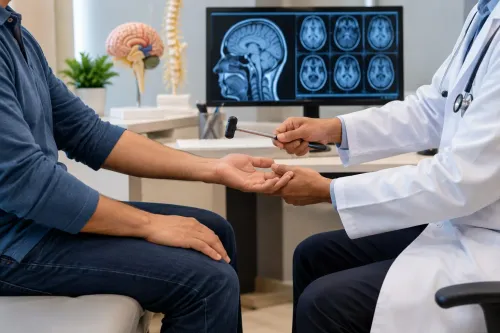
Your first appointment starts with a history, not a scan. Tell the neurologist when weakness began, whether it is worsening, which tasks fail, and what medicines, illnesses, strenuous exercise, or supplements preceded it. A neurologic examination tests individual muscle groups, compares both sides, and checks reflexes, sensation, coordination, eye movements, speech, and gait.
| Test | What it helps identify | When it is useful |
|---|---|---|
| Neurologic examination | Muscle, nerve, spinal, brain, or neuromuscular-junction patterns | Every weakness assessment |
| Creatine kinase test | Muscle-fibre injury or inflammation | Suspected muscle disease; a normal result does not exclude myasthenia gravis or neuropathy |
| Thyroid and vitamin B12 testing | Treatable metabolic or nutritional contributors | When symptoms or examination suggest systemic causes |
| Electromyography and nerve conduction studies | Muscle versus peripheral nerve, nerve-root, or neuromuscular-junction dysfunction | When localisation remains uncertain or neuropathy is suspected |
The neurologist chooses further testing from that pattern. Antibody tests may investigate myasthenia; MRI may assess brain or spine disease; genetic testing, muscle MRI, or biopsy fits selected cases. A routine MRI cannot replace electromyography and nerve conduction studies.
Avoid two common errors:
- Do not start high-dose vitamins, creatine, or “nerve” supplements before testing; excess vitamin B6 can itself cause neuropathy.
- Do not exercise through steadily worsening weakness, falls, dark urine, or reduced urine output. Strenuous exercise can temporarily raise CK and confuse interpretation.
Dr Jharna P Mahajan (Bhanushali) can help match the examination pattern to the smallest useful set of neuromuscular tests.
Related services
Neuromuscular Disorders (Special Focus) Neuromuscular Disorders (Special Focus) Dr. Mahajan has advanced training and a deep interest in diagnosing and managing neuromuscular disorders—conditions that affect the muscles,... View service → |
Myasthenia Gravis and Neuromuscular Junction Disorders Myasthenia Gravis and Neuromuscular Junction Disorders These are autoimmune conditions affecting the communication between nerves and muscles: • Myasthenia Gravis: Presents with drooping eyelids, double... View service → |
Frequently asked questions
What counts as persistent muscle weakness?
It is reduced force that continues, repeatedly returns, or fails to improve after sleep and ordinary rest. Unexplained weakness beyond expected recovery deserves assessment.
Which weakness symptoms need emergency care?
Seek emergency care for sudden weakness, especially with facial drooping, speech difficulty, severe imbalance, confusion, or breathing or swallowing problems.
When should gradual weakness be reviewed by a neurologist?
Arrange a neurological review when weakness worsens, keeps returning, has no clear cause, or interferes with walking, climbing stairs, lifting, dressing, or other daily tasks.
What happens during an evaluation for possible muscle disease?
The neurologist reviews the timeline and pattern, examines strength, reflexes, sensation, coordination, and movement, then selects tests based on the findings.
Related service
Motor Neuron Diseases (including ALS) Motor Neuron Diseases (including ALS) Motor neuron diseases cause progressive weakness and disability: • Amyotrophic lateral sclerosis (ALS): Involves both upper and lower motor... View service → |